Profile of Patients Who Died During One Year in the Pneumophthisiology Department of the Hospital National Ignace Deen CHU in Conakry

Abstract
Introduction
Mortality is one of the most important demographic phenomena in public health, and its rate is the primary indicator of a population's state of health. The aim of this study was to describe the profile of patients in the pneumo-phthisiology department of the Hospital National Ignace Deen CHU in Conakry.
Methodology
This was a retrospective descriptive study lasting one year, from 01 January to 31 December 2023, on 176 records of hospitalized patients who died in the pneumophthisiology department of the Ignace Deen National Hospital.
Results
A total of 1043 patients were hospitalized during our study period, 176 of whom died, giving a mortality rate of 16.87%. The mean age of the deceased patients was 49.57±18.8 years, with a male predominance (sex ratio=1.93). Clinical signs on admission were dominated by dyspnoea (70.45%) and chest pain (61.36%). Tuberculosis was the most common diagnosis with a frequency of 42.61%, followed by TB/HIV co-infection with a frequency of 22.16%. The average length of hospitalization was 8.79 days. Probable cause of death was dominated by respiratory distress (54.44%) and decompensated anaemia (32.95%).
Conclusion
Mortality in the pneumo-phthisiology department of the Ignace Deen National Hospital remains high. Anemia and respiratory distress were the most common diagnoses of severity, hence the need to improve management of these probable causes of death.
Article Information
- Received
- Accepted
- Published
Academic Editor: Sasho Stoleski, Institute of Occupational Health of R. Macedonia, WHO CC and Ga2len CC.
Checked for plagiarism: Yes
Review by: Single-blind
Copyright © 2024 Boubacar Djelo Diallo, et al.
 This is an open-access article distributed under the terms of the Creative Commons Attribution License, which permits unrestricted use, distribution, and reproduction in any medium, provided the original author and source are credited.
Corresponding author: Boubacar Djelo Diallo, Faculty of Health Sciences and Techniques, Gamal Abdel Nasser University, Conakry, Pneumo-Phtisiology, Department, Ignace Deen University Hospital, Conakry —
Competing Interests
The authors have declared that no competing interests exist.
Funding
No specific funding statement was provided by the authors.
Data Availability
No data-availability statement was provided by the authors.
Citation:
Introduction
Mortality is one of the most important demographic phenomena in public health, and its rate is the primary indicator of a population's state of health 1. Diseases affecting the upper and lower airways come from a variety of sources and can be acute or chronic. The most involved are those of infectious and tumour origin, and their impact on global health is significant 2, 3. Asthma, chronic obstructive pulmonary disease (COPD), acute respiratory infections, tuberculosis and lung cancer are the main pathologies contributing to the global burden of respiratory diseases and are among the ten leading causes of death worldwide 4, 5. They are a major cause of morbidity and mortality, accounting for 56.9 million deaths worldwide 2, 3.
Mortality varies from region to region. In developed countries, chronic respiratory diseases play an important role: the prevalence of chronic obstructive pulmonary disease (COPD) worldwide is estimated at 9.33/1000 in men and 7.39/1000 in women; the prevalence of asthma varies from 1 to 9.7/1000 depending on the region 6. In Europe, there are 1 million deaths due to respiratory diseases, with a predominance of smoking-related diseases such as lung cancer and COPD 3. In Africa, on the other hand, respiratory infections are the main cause of death from respiratory disease2. According to the World Health Organisation (WHO), tuberculosis is the leading cause of death due to a single infectious agent, accounting for around 2 million deaths worldwide every year 7. Given demographic trends, improvements in healthcare and rising incomes, the burden of communicable diseases is expected to decline, while the burden of chronic respiratory diseases will increase due to smoking and an ageing population 5.
In Guinea 8 in 2017, a study carried out in the pneumo-physiology department reported that tuberculosis (68.94%) and bacterial pneumopathy (10.55%) were the most frequent diagnoses for hospitalisation. The case fatality rate by pathology was 22% for tuberculosis, 32% for COPD (decompensations) and 33% for bronchial cancers. Given this high case-fatality rate, we felt it was imperative to carry out a review of deaths, with the aim of helping to reduce patient mortality in the HNID pneumo-phthisiology department.
Methodology
This was a retrospective descriptive study lasting one year, from 01 January to 31 December 2023, on 176 inpatient records of patients who died in the pneumophthisiology department of the Ignace Deen National Hospital, irrespective of sex, age or other socio-professional category.
To collect the data, we used a literature review based on their medical records and the consultation register:
· Clinical variables (socio-demographic data, clinical signs, level of care, co-morbidities, vices, positive diagnosis, diagnosis of severity, probable causes of death, length of hospital stay).
· The quality of care was assessed by evaluating the correlation between symptoms, physical examination, paraclinical signs and the final diagnosis. In addition, a lack of care was cited when medical prescriptions were not honoured.
· Paraclinical variables (CBC, urea, blood glucose, urea and creatinine, Xpert MTB/Rif, ECBC, pleural fluid analysis, frontal chest X-ray, chest CT scan).
· Data were collected manually on pre-established survey forms and analysed using SPSS software. We calculated means and standard deviations for quantitative variables and proportions for qualitative variables.
Results
A total of 1043 patients were hospitalised during our study period in the pneumo-phthisiology department of the Ignace Deen National Hospital, 176 of whom died, giving a mortality rate of 16.87% (Figure 1). The majority of patients were male (65.90%), with a sex ratio of 1.93. The majority of patients were elderly: 40.34% were over 60 years of age, with an average age of 49.57±18.8 years. 51.94% of our patients were from Conakry, and 68.18% had not been managed properly. Tuberculosis was the most common medical history with a frequency of 70.37% (Table 1). As regards comorbidities, HIV was found in 58.57% of cases. Smoking was present in 70.27% of our patients. The clinical picture of the patients was marked by respiratory signs dominated by dyspnoea in 70.45% of cases and chest pain in 61.36% of cases, followed by general signs in 70.95% of cases. X-rays revealed an alveolar syndrome in 65.56% of cases. Tuberculosis was the most common diagnosis with a frequency of 42.61%, followed by TB/HIV co-infection with a frequency of 22.16%. Signs of severity were dominated by anaemia (61.93%). The prevalence of mild, moderate and severe anaemia was 30%, 32.39% and 11.93%, respectively. The average length of hospital stay was 8.79 days. Probable cause of death was dominated by respiratory distress (54.44%) and decompensated anaemia (32.95%) (Table 2, Table 3).
Figure 1. Flow chart for deceased patients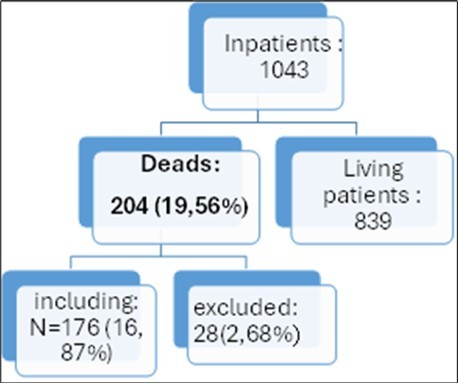
Download figure
| Number (N=176) | % | |
| Age | ||
| 20-29 | 20 | 11,4 |
| 30-39 | 35 | 19,9 |
| 40-49 | 25 | 14,2 |
| ≥60 | 71 | 40,3 |
| Gender | ||
| Male | 116 | 65,9 |
| Female | 60 | 34,1 |
| Level of care | ||
| Good PEC | 56 | 31,8 |
| Lack of ECP | 120 | 68,2 |
| Workforce | % | |
| AVC | 2 | 7,4 |
| Gastritis | 4 | 14,8 |
| COPD | 2 | 7,4 |
| Tuberculosis | 19 | 70,4 |
| Total | 27 | 100 |
| Workforce | % | |
| Respiratory distress | 96 | 54,6 |
| Hypoglycaemia | 5 | 2,8 |
| Decompensated anaemia | 58 | 33 |
| Acute haemoptysis | 5 | 2,8 |
| Septic shock | 8 | 4,6 |
| Cardiogenic shock | 2 | 1,1 |
| Cerebral toxoplasmosis | 2 | 1,1 |
| Total | 176 | 100 |
Discussion
The mortality rate of 16.86% found in our work is comparable to that of Touré N.O. et al.9 in Senegal, who reported a mortality rate of 17%. However, our results were lower than those reported by Sissoko BF et al. 6 and Samaké K et al 3 who reported 29.95% and 34.4% deaths respectively. These deaths could be explained by the delay in consultation, the low level of technical facilities and the lack of knowledge of patients about their state of health. In our regions, patients tend to wait for their illness to worsen before consulting a health facility. The majority of patients were male in 65.90% of cases, with a sex ratio = 1.93. This result was similar to those reported by Samaké K et al. 3 and Ouédraogo SM et al 10 who found 61.58% and 64.1% respectively. These results were in correlation with current data in the literature, which place the male sex at much greater risk of respiratory pathologies 11, 12.
The majority of patients were elderly, with 40.34% aged over 60 years and a mean age of 49.57 years. This result was similar to that reported by Sissoko BF et al 6 in Mali and Dell'Accio T 12 in France who reported 32.3% of patients between 60 and 95 years of age and a mean age of 50.7 years. However, our results differed from those of Ouédraogo SM et al.10 in Burkina Faso, who reported an average age of 44.4 years. These results would be in line with the data in the literature showing that this age group is much more exposed to respiratory pathologies. 51.94% of our patients came from Conakry. This result was similar to that of Sissoko BF et al. 6. This result could be explained by the fact that the pneumology-physiology department of the HNID, CHU de Conakry remains the only reference centre for respiratory diseases in the country. In an analysis of 68.18% of patients, the ECP was inadequate. This result was similar to that of Desalu OO et al. 5 in Nigeria, who found that 81.4% of deceased patients had inadequate ECP. These results have a major impact on the course of patients' disease from the outset. In fact, several studies have identified poor ECP and precariousness as factors favouring the onset of pathologies in general, and pulmonary pathologies in particular, as well as their aggravation 5, 13.
Tuberculosis was the most common medical history in our patients, with a frequency of 70.37%. This result was comparable to that of Samaké K et al 3 and Sissoko BF et al 6 who found pulmonary tuberculosis in 38.1% and 12.2% of their patients respectively. These results could be explained by the high level of tuberculosis endemicity in Africa in general, and in our context in particular, due to the low standard of living of the population and promiscuity, which remain factors favouring the proliferation of the disease, but also because of the high prevalence of HIV; in fact, tuberculosis is the main opportunistic HIV infection. In terms of co-morbidities, HIV was found in 58.57% of cases. This result is similar to that of Samaké K et al. in Côte d'Ivoire 3 42.18%, but higher than that reported by Desalu OO et al. 5 in Nigeria (11.5%).
Smoking was present in 70.27% of our patients. This result was similar to that reported by many authors 13, 3, 8 making smoking one of the main risk factors for respiratory disease. The clinical picture of the patients was marked by respiratory signs dominated by dyspnoea in 70.45% of cases and chest pain in 61.36% of cases, followed by general signs dominated by deterioration in general condition (asthenia + anorexia + weight loss) in 70.95% of cases. These results are in line with the literature, which considers dyspnoea to be a clinical sign pointing to respiratory and pulmonary disorders 14, 12. X-rays revealed an alveolar syndrome in 65.56% of cases. This result was similar to that of Samaké K et al 3 who found diffuse alveolar-interstitial or interstitial lesions in 67.80% of patients.
Tuberculosis was the most common diagnosis with a frequency of 42.61%, followed by TB/HIV co-infection with a frequency of 22.16%. This predominance of tuberculosis in pneumology departments was also highlighted by Samaké K et al. 3 i.e. 49.69%, Ouédraogo SM et al.10 i.e. 43.3% and Desalu OO et al 5. (32%). This could be explained by the high endemicity of tuberculosis in Africa, but also by the prevalence of HIV. According to the WHO, tuberculosis is one of the most common communicable diseases causing death in the world, alongside HIV. Signs of severity were dominated by anaemia (61.93%). The prevalence of mild, moderate and severe anaemia was 30%, 32.39% and 11.93%, respectively. Our result was similar to that of Diaw A et al 15 who reported decompensated anaemia in 59.07% of cases. These results would correlate with current data in the literature which stated that anaemia is the most common severity factor present in TB and was evident in more than half of TB patients 16. The average length of hospital stay was 8.79 days. This result was similar to that of Touré NO et al 9 in Senegal, who reported an average length of hospitalisation of 8 days (64.4%). This result could be explained by the delay in consultation of patients, who usually head for specialised services after the failure of self-medication and the worsening of their clinical picture, which would lead to their death in the days following admission to the service. The probable cause of death was dominated by respiratory distress (54.44%) and decompensated anaemia (32.95%). This result was similar to that of Touré NO et al. in Senegal 9 who reported respiratory distress in 37.06%. This could be explained by the fact that in a pneumo-phthisiology department, almost all conditions have a direct impact on the lung parenchyma.
Conclusion
Mortality in the pneumo-phthisiology department of the Ignace Deen National Hospital remains high. Males were the most affected, along with an elderly population. Tuberculosis and HIV infection accounted for a large proportion of all causes of death, and anaemia and respiratory distress were the most common diagnoses of seriousness. Prompt treatment of these conditions would reduce mortality.
References
- 1.Benbekhti S, Saïm H, Chabni N, Attar S, Rouigueb K et al. (2013) Hospital mortality at the university hospital of Tlemcen. , Algeria, Journal of Epidemiology 64, 256-7.
- 2.BEC Francoise, Thérese A M, Jacques Z J, MAJ Claude, Massongo M et al. (2018) Profile of respiratory diseases of hospitalized patients at the pneumology unit of Jamot Hospital. Yaounde. The Journal of Medical Research 4(5), 245-8.
- 3.Samaké K, Bakayoko I, Koné Z, ATJ Daix, Kilanko G E et al. (2024) Causes and factors associated with the death of patients in the pulmonology department in Abidjan, Ivory Coast. J Func Vent Pulm 46(15).
- 4.Kishamawe C, Rumisha S F, Mremi I R, Bwana V M, Chiduo M G et al. (2006) Trends, patterns and causes of respiratory disease mortality among inpatients in Tanzania. Tropical Medicine & International Health 24(1), 91-100.
- 5.Desalu O O, Oluwafemi J A, Ojo O. (2009) Respiratory diseases morbidity and mortality among adults attending a tertiary hospital in Nigeria. Jornal Brasileiro de Pneumologia. 35, 745-52.
- 6.Sissoko B F, Baya B, Soumaré D, Ouattara K, Kanouté T et al. (2016) Epidemiological and diagnostic characteristics of patients who died in the pneumo-phthisiology department of the Point G University Hospital. Revue Malienne d'Infectiologie et de Microbiologie.
- 7.Ngakoutou R. (2023) Risk factors for death from bacilliferous pulmonary tuberculosis in patients hospitalised in the pneumo-physiology department of the Centre Hospitalier Universitaire la Référence Nationale (CHU-RN) in N'Djamena. Revue Malienne d'Infectiologie et de Microbiologie. 18(2), 1-5.
- 8.Diallo B D, Diallo A, Diallo O H, Camara M H, Barry A O et al. (2019) Sociodemographic and clinical profile of patients admitted to pneumology hospital in Conakry (Guinea). Journal of Respiratory Diseases. 36-129.
- 9.Touré N O, Kane Y D, Diatta A, Thiam K, Cissé M F et al. (2013) Mortality in a pneumology department in Dakar. Revue des Maladies Respiratoires. 30-118.
- 10.Ouedraogo S, Kouanda S, Badoum G, Ouedraogo G, Dembele S et al. (2010) Morbi- mortalité en pneumologie au CHU Yalgado Ouédraogo de Ouagadougou: place de la tuberculose. Sciences de la Santé [Internet].
- 11.Chavaillon J M, Lerousseau L, David P, Martin F, Lamour C et al. (2010) Intra-hospital mortality during acute exacerbations of COPD. EABPCO-CPHG study by the Collège des pneumologues des hôpitaux généraux (CPHG). Journal of Respiratory Diseases 27(7), 709-16.
- 12.Dell'Accio T. Review of Morbidity and Mortality in a Pneumology & Thoracic Oncology Department (Chambéry Hospital) over a 4-year period (2006-2010).
- 13.Koné Z, Samake K, Bomouan J F, ATJ Daix, Assi R et al. (2023) Multidrug-resistant tuberculosis and mortality: factors associated with death in patients with multidrug-resistant pulmonary tuberculosis admitted to a pneumology hospital in Abidjan (Côte d'Ivoire). Revue des Maladies Respiratoires Actualités. 15-1.
- 14.Loua C L, Millogo T, Baguiya A, Méda B, Coulibaly A et al. (2017) Death risk factors in pulmonary tuberculosis infected patients at Yalgado Ouedraogo Teaching University hospital of Ouagadougou, Burkina Faso: a case control study. Health Sciences. 40-2.