Spiritual Blessing Energy Treatment as an Approach for Boosting Growth and Yield of Bottle Gourd (Lagenaria siceraria L.)

Abstract
The objective of this study was to improve the growth and yields of bottle gourd plants after exposure of the seeds and land to spiritual blessing energy treatment (SBET). Twenty-one morphological traits of leaves, fruit, seed, and twenty-eight phenological parameters were employed to evaluate bottle gourd’s growth and yields after SBET. Results of bottle gourd showed a diversifiable characteristic of leaves, fruits, and seeds. Nine qualitative traits exhibited distinct differences in the biofield-energy treatment group compared to the control. At harvest, growth-related phenological parameters such as plant vine length, number of branches, internodal length, and leaf width were significantly improved in the treatment group by 65.43% (p ≤ 0.001), 51.78% (p ≤ 0.01), 49.40% (p ≤ 0.001), and 40.82% (p ≤ 0.001), respectively, compared to the control. Additionally, yield-related parameters such as number of female flowers, number of fruits per vine, and fruit yield per hectare were significantly increased by 47.73% (p ≤ 0.05), 26.52% (p ≤ 0.001), and 38.99% (p ≤ 0.05), respectively, with respect to the control. With distinct qualitative variations and high statistical significance, these results suggest that SBET may serve as a potent non-traditional intervention for optimizing phenological development and agricultural output of bottle gourd.
Article Information
- Received
- Accepted
- Published
Academic Editor: Anubha Bajaj, Consultant Histopathologist, A.B. Diagnostics, Delhi, India
Checked for plagiarism: Yes
Review by: Single-blind
Copyright © 2026 Mahendra Kumar Trivedi, et al.
 This is an open-access article distributed under the terms of the Creative Commons Attribution License, which permits unrestricted use, distribution, and reproduction in any medium, provided the original author and source are credited.
Corresponding author: Snehasis Jana, Trivedi Science Research Laboratory, Pvt, Ltd., Research and Development, Thane (W), Maharashtra, India —
Competing Interests
Author DT was employed by Trivedi Global, Inc. VDK, TBG, and NRP were employed by Shree Angarsiddha Shikshan Prasarak Mandal’s College of Agriculture, Sangulwadi, Mohitewadi, Maharashtra, India.Authors SM and SJ were employed by Trivedi Science Research Laboratory Pvt. Ltd. The authors do not have any commercial interests on the objectivity of the research.
Funding
The authors declare that no funds, grants, or other support were received during the preparation of this manuscript.
Data Availability
No data-availability statement was provided by the authors.
Acknowledgements
The authors are grateful to Divine Connection Foundation for the assistance and support during the work.
Citation:
Introduction
Bottle gourd (Lagenaria siceraria L.) belongs to Cucurbitaceae family is the most ancient crops mainly cultivated during summer throughout the world. It is also known as White flower gourd, Calabash, Doodhi, and Lauki in different geographical locations 1. The bottle gourd fruit contains most of all essential nutrients such as proteins, carbohydrates, fibres, minerals (calcium, phosphorous, iron), and vitamins (thiamin, riboflavin, niacin). Apart from fruits its byproducts such as seeds, peel, and leaves also had nutritional value and were rich sources of various bioactive compounds such as flavonoids, phenolic acids, lignans, saponins, glycosides, cucurbitacins, and triterpenoids, responsible for antioxidant, anti-inflammatory, antidiabetic, and antimicrobial activities 2. The seeds also contribute a good source of lipids (45%) and proteins (35%). The fatty acid profile such as linoleic acid (62%), oleic (16.2%), palmitic (14.4%), and stearic (5.8%) 3. Like fruits, the leaf and stem of the bottle gourd plant were widely consumed as vegetables 4. Lagenaria siceraria is a vigorous climbing annual vine characterized by its large, musk-scented white flowers and fruits that vary significantly in shape and size. Economically, it serves as a critical source of income for small-scale farmers 5. Despite its hardiness, bottle gourd production faces several challenges that impact overall yield and quality such as pathogenic stress 6, environmental sensitivity, and chemical over-reliance. Fluctuations in temperature and soil moisture can lead to poor fruit set and bitterness (caused by cucurbitacins). Heavy use of synthetic fertilizers and pesticides to boost growth has raised concerns regarding soil health and consumer safety 7. In recent years, with the paradigm shift between biofield and spiritual energy treatments, the scientific community has explored "non-traditional" bio-stimulants to enhance agricultural productivity without chemical intervention. Spiritual Energy Treatment, often categorized under Biofield Energy Healing, involves the redirection of subtle energies to influence the physiological and genetic characteristics of living organisms8. Based on the above facts the current research hypothesized that Spiritual Blessing Energy Treatment (SBET) might enhance germination, plant growth and development, and yield superiority compared to the untreated group.
Materials and Methods
Study site, test items, and plot design
The study took place on agricultural land in Bhandarwadi, Sindhudurg district, Maharashtra, India, spanning February to June 2025. The location lies between latitudes 15° 37’–16° 40’ N and longitudes 73° 19’–74° 13’ E, with an altitude of 26 meters. The area experiences hot summers and cool winters, with temperatures peaking at 40℃ during April and May and dropping to 8–25℃ between December and February. Rainfall patterns are unpredictable, often leading to dry periods and limited soil moisture for crops. Seeds of Vinayak hybrid bottle gourd (Lagenaria siceraria L.) with a genetic purity of 95% (label number: A4-63795, lot number: 19906636) were sourced from Namdeo Umaji Agritech (India) Pvt. Ltd. The seeds/land were divided into two sets: one set was left untreated as a control, while the other set, designated as treated, was exposed to Blessings/BET/prayers. Both sets were cultivated under identical conditions using the same irrigation, fertilization, and pesticide protocols on the selected farmland. Subsequent growth, appearance, and yield were then assessed and compared between the two groups. RCBD (Randomized Complete Block Design) was used in this study, featuring two distinct groups: a control group (CONBOGG) with no spiritual blessing and a treatment group (BTBOGG) that received biofield (blessing) energy on both seeds and land. Each group was replicated three times, with each block containing two plots—one assigned as control and the other as treatment. Plot assignments within each block were randomized. In total, six plots were established, each measuring 4.5 meters by 2.5 meters. Plant spacing was kept at 0.5 meters both between and within rows, while a 0.5-meter buffer separated replications and plots. The overall experimental area was 80 square meters, with each plot occupying 11.25 square meters. Prior to sowing, the fields were cleared and prepared, and standard fertilizer rates (50, 100, and 50 kg NPK per hectare) were applied to each plot and mixed into the soil.
Spiritual energy treatment (blessing/prayer) strategy
The bottle gourd seeds and plots were divided into two groups: a control group (CONBOGG) that did not undergo any intervention, and a treated group (BTBOGG) that was exposed to a spiritual energy practice. The BTBOGG group received a biofield energy treatment, commonly referred to as a blessing or prayer, administered by an experienced practitioner Mrs. Dahryn Trivedi with over 12 years in the field. This treatment involved the practitioner directing energy toward the seeds and soil, maintaining a distance of about 1.5 feet, without any physical contact. The session lasted approximately four minutes, conducted at a temperature of 28 ± 2°C and a relative humidity of 65 ± 5%. The practitioner's intention was to transmit universal energy to enhance the seeds and land.
Soil properties and farming
The soil used in the experiment was characterized as sandy loam, noted for its low natural fertility and effective drainage properties. Prior to applying treatments, topsoil samples (collected to a depth of 30 cm) were collected from each plot using a five-point sampling approach. These samples were air-dried, passed through a 2 mm sieve, and stored at 4 °C until further analysis. Soil texture was assessed using the hand-feel technique 9, and soil pH was determined in a 1:2 (w/v) soil-to-water mixture with a calibrated digital pH meter. The seeds were sown directly in the field, and for the first nine days after sowing (DAS), soil moisture was maintained by manual irrigation. Thereafter, a drip irrigation system with self-compensating emitters (spaced 0.5 m apart, each delivering 3 L h⁻¹) was used. Basal fertilizer was applied at a rate of 50:100:50 kg ha⁻¹ N:P:K using urea, single superphosphate (SSP), and muriate of potash (MOP). All of the SSP and MOP, along with half of the urea, were mixed into the soil before sowing; the remaining urea was top-dressed at 21 DAS. Insect management involved spraying Hamla 550 (Gharda Chemicals Ltd., India) at 2 mL L⁻¹ on days 21 and 49 after sowing for all treatments. At 80 DAS, five plants per plot were randomly sampled to evaluate vegetative growth and yield parameters.
Vegetative growth and yield parameters
Morphological traits were analyzed using both qualitative and quantitative approaches. The qualitative aspects assessed were plant vigour, type of growth habit, stem formation, presence of leaf pubescence, degree of lobing, coloration of the leaf blade, variations in leaf width and lobing, colour of fruit skin, shape and form of the fruits, seed pigmentation, and seed content. For quantitative data, measurements involved vine length (m), count of primary branches, number of nodes along each vine, internode length (cm), stem thickness (cm), dimensions of the leaf blade (length and width in cm), number of days until 50% flowering, mass of fruit (g), length and diameter of fruit (cm), total yield (t ha⁻¹), and seed metrics (length and width in cm). Fruits from the bottle gourd were collected at the stage of physiological maturity. The sizes of fruits were recorded in centimetres, and their weights were measured using a digital scale. The yield from each net plot (kg) was then converted to tonnes per hectare with the use of a standard calculation method.
Statistics
Data are expressed as mean ± standard error of the mean (SEM). Differences between two independent groups were assessed using Student’s t-test in SigmaPlot (v14.0). Statistical significance was set at p < 0.05.
Results
Analysis of soil properties
The soil used in the experiment was identified as sandy loam, characterized by high bulk density, low organic matter, limited total nitrogen, and deficient exchangeable cations (Ca, Mg, and Na), all pointing to poor natural fertility. Before planting commenced, the control (CONBOGG) soil had a strongly acidic pH of 5.01, which typically reduces cation exchange capacity and restricts nutrient uptake. After applying spiritual blessing/BET, the soil pH rose to 5.86, reflecting a shift to moderately acidic conditions (data not shown).
Morphology of bottle gourd
Growth-related morphological characteristics of bottle gourd were recorded from time to time. The growth of bottle gourd from the phases of germination, seedling, plant vegetative growth, flowering, fruiting, and harvesting is shown in Figure 1.
Figure 1. Representative images depict the progression of vegetative growth characteristics in bottle gourd across various developmental stages. C: Control group; BET: Blessing/biofield energy treatment group.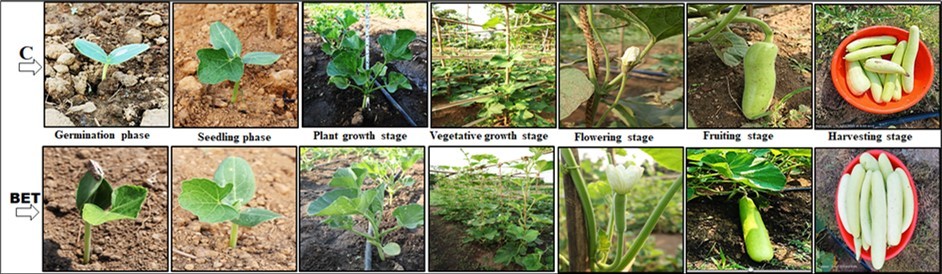
Download figure
Effects of blessing (biofield) energy treatment on qualitative vegetative parameters of bottle gourd at 80 days after sowing (DAS) are shown in Table 1. Early plant vigour was rated as very good in the biofield energy-treated group (BTBOGG), compared to good in the control group (CONBOGG). Vine length was greater in BTBOGG, while CONBOGG exhibited medium vine length. Stem pubescence was dense in BTBOGG and medium in CONBOGG. Leaf size was large in BTBOGG and medium in CONBOGG. Leaf pubescence was very soft in BTBOGG and soft in CONBOGG. The upper surface of the leaf blade was dark green in BTBOGG and medium green in CONBOGG. Fruit skin colour was dark green in BTBOGG and medium green in CONBOGG. Seed colour was brown in BTBOGG and light brown in CONBOGG. The number of seeds per fruit was higher in BTBOGG, whereas CONBOGG had a medium number of seeds. Other parameters followed a similar pattern in both groups (Table 1).
Table 1. Impact of biofield energy blessing on vegetative quality traits of bottle gourd at 80 days post-sowing| Vegetative trait | Control group (CONBOGG) | Treated group (BTBOGG) |
| Early plant vigour | Good | Very good |
| Plant growth habit | Medium vine (2.5-4 m) | Long vine (>4 m) |
| Stem shape | Angular | Angular |
| Stem pubescence | Medium | Dense |
| Tendril | Present | Present |
| Tendril type | Coiled | Coiled |
| Tendril branching | Branched | Branched |
| Leaf margin | Entire | Entire |
| Leaf size | Medium | Large |
| Leaf blade shape | Cordate | Cordate |
| Leaf pubescence | Soft | Very Soft |
| Leaf blade colour (upper side) | Medium green | Dark green |
| Number of lobes in leaf blade | 3 lobes | 3 lobes |
| Sex type | Monoecious | Monoecious |
| Flower colour | White | White |
| Fruit skin colour | Medium green | Dark green |
| Fruit longitudinal shape | Cylindrical | Cylindrical |
| Fruit shape at blossom end | Semi blunt | Semi blunt |
| Fruit pubescence | Present | Present |
| Fruit taste | Sweet | Sweet |
| Seed colour (at the mature harvest stage) | Light brown | Brown |
| Seediness (number of seeds/ fruit) | Medium (150-300) | Large (>300) |
Phenology and yield traits
The germination rate in BTBOGG was increased significantly by 18.03% (p ≤ 0.001) compared to CONBOGG. At harvest, plant vine length in BTBOGG was 65.43% greater (p ≤ 0.001) than in CONBOGG. The number of branches and nodes per vine in BTBOGG significantly rose by 51.78% (p ≤ 0.01) and 35.88%, respectively, compared to CONBOGG. Internodal length and stem diameter in BTBOGG significantly increased by 49.40% (p ≤ 0.001) and 13.61% (p ≤ 0.05), respectively, relative to CONBOGG. The number of leaves per plant, leaf length, and leaf width were significantly higher in the BTBOGG by 18.51% (p ≤ 0.01), 33.27% (p ≤ 0.001), and 40.82% (p ≤ 0.001), respectively, compared to the CONBOGG. Significant differences were observed in the timing (days) of first male (p ≤ 0.05) and female (p ≤ 0.001) flower appearance in BTBOGG compared to CONBOGG. The number of male and female flowers in BTBOGG increased by 46.09% (p ≤ 0.01) and 47.73% (p ≤ 0.05), respectively, relative to the CONBOGG. The spiritual blessing treatment group took less time (9.79%) to cover 50% flowering than control. Fruit length and fruit width in BTBOGG increased by 21.66% (p ≤ 0.05) and 36.42% (p ≤ 0.001), respectively, compared to CONBOGG. Seed length, seed width, seed count per fruit, and 100-seed weight in BTBOGG were significantly (p ≤ 0.001) increased by 29.60%, 80%, 29%, and 19.97%, respectively, compared to CONBOGG. The number of fruits per vine was significantly (p ≤ 0.001) by 26.52% higher in BTBOGG than in CONBOGG. Fruit yield (ton per hectare) was 38.99% higher in BTBOGG compared to CONBOGG (Table 2).
Table 2. Spiritual Energy (Prayer) Applications: Impact on Phenological Development and Yield in Bottle Gourd| Vegetative trait | Control group (CONBOGG) | Treatment group (BTBOGG) |
| Days to germination | 6-8 | 6-7 |
| Germination percentage | 83.54 ± 0.35 | 98.60 ± 0.31*** |
| Plant height/Vine length (m) | 3.24 ± 0.21 | 5.36 ± 0.24*** |
| Number of primary branches/vine | 5.35 ± 0.55 | 8.12 ± 0.33** |
| Number of nodes/vine | 83.27 ± 2.67 | 113.15 ± 4.38*** |
| Internode length (cm) | 11.58 ± 0.32 | 17.30 ± 0.75*** |
| Stem diameter (cm) | 1.47 ± 0.07 | 1.67 ± 0.04* |
| Number of leaves per plant | 176.58 ± 4.03 | 209.26 ± 6.04** |
| Leaf length (cm) | 15.27 ± 0.43 | 20.35 ± 0.92*** |
| Leaf width (cm) | 12.15 ± 0.24 | 17.11 ± 0.73*** |
| Days to first male (staminate) flower appearance | 36.47 ± 0.21 | 34.06 ± 0.75* |
| Days to first female (pistillate) flower appearance | 42.15 ± 0.64 | 36.73 ± 0.49*** |
| Days to 50% flowering | 54.64 ± 1.31 | 49.29 ± 1.31* |
| Number of male flowers | 53.14 ± 4.12 | 77.63 ± 5.47** |
| Number of female flowers | 21.54 ± 2.68 | 31.82 ± 1.96* |
| Days to first harvest | 73.15 ± 1.68 | 69.66 ± 1.93 |
| Peduncle length (cm) | 10.36 ± 0.21 | 11.35 ± 0.62 |
| Fruit weight (kg) | 1.56 ± 0.12 | 1.82 ± 012 |
| Crop duration (days) | 117.54 ± 3.12 | 117.46 ± 3.22 |
| Fruit length (cm) | 29.64 ± 1.98 | 36.06 ± 1.54* |
| Fruit width (cm) | 11.34 ± 0.82 | 15.47 ± 0.28*** |
| 100-seed weight (gm) | 14.27 ± 0.06 | 17.12 ± 0.02*** |
| Seed length (cm) | 1.25 ± 0.04 | 1.62 ± 0.02*** |
| Seed width (cm) | 0.45 ± 0.01 | 0.81 ± 0.02*** |
| Seed count/fruit | 267.25 ± 3.31 | 344.75 ± 4.47*** |
| Number of fruits per plant | 5.58 ± 0.25 | 7.06 ± 0.13*** |
| Fruit yield (kg) | 42.17 | 58.59 |
| Fruit yield/sq. m plot (kg/sq. m) | 1.25 | 1.74 |
| Fruit yield/hectare (ton/ha) | 12.49 | 17.36 |
Discussion
This study showed a significant enhancement of vegetative growth as evidenced by an increase in vine length and number of branches. This suggests that Spiritual Blessing Energy Treatment (SBET) may influence the primary and secondary meristems, potentially accelerating cell division or elongation. Similar results have been reported in other biofield studies. For instance, Trivedi et al. (2015) observed significant increases in plant height and branching in mustard and chickpea crops following biofield energy treatment 10, 11. It is hypothesized that such treatments may alter the metabolic rate or nutrient uptake efficiency, leading to more robust vegetative architecture. Optimization of phenological development as evidences of significant increase in internodal length and increase in leaf width. These wider leaves have increased the surface area for photosynthesis. This "compact but productive" growth pattern is often a goal in high-yield agriculture. Research into audible sound frequencies and mantras has shown that specific vibrations can influence leaf morphology and chlorophyll content, suggesting that plants are sensitive to subtle environmental stimuli beyond light and water 12.
The most critical agricultural finding is the substantial improvements in fruit yield per hectare. This is driven by a higher density of female flowers (47.73% increase) and fruits per vine (26.52% increase). If we see the yield correlation in bottle gourd, the ratio of male-to-female flowers is a major yield-limiting factor. The ability of SBET to significantly shift this ratio toward female flowers suggests an influence on the hormonal pathways (like gibberellins or ethylene) that govern sex expression. Prasad et al., 2024, have documented similar yield boosts across various crops, suggesting that "life force" or "biofield" energy may stabilize plant health and maximize reproductive output 13.
Related to the qualitative transformations this study notes "distinct differences" in nine qualitative traits of the treated group compared to the control. These include variations in leaf, fruit, and seed characteristics. Biofield treatments have been linked to changes in the physical and structural properties of treated materials 14. In biological systems, this may manifest as enhanced resistance to stress or altered phenotypic expression, often referred to as "adaptive micropropagation response."
Theoretical implications and future directions
While the results are statistically significant, the underlying mechanism, often termed the "Trivedi Effect®" or "Spiritual Biofield Energy/Blessing/Prayers", remains a subject of interdisciplinary study involving quantum biology and biophysics. Future studies will focus on biochemical analysis (e.g., changes in enzyme activity, protein expression, or DNA polymorphism) to provide a molecular basis for these morphological changes. SBET represents a cost-effective and environment-friendly "green" technology. Unlike chemical fertilizers, it leaves no residue and potentially improves soil health simultaneously.
Conclusion
The current investigation determined that Spiritual Blessing Energy (Trivedi Effect®) treated bottle gourd was recorded maximum number of female flowers, number of fruits per plant, and average yield per hectare which was more productive and economically viable. The application of Spiritual Blessing Energy Treatment (SBET) to seeds and soil significantly enhances the growth and productivity of bottle gourd plants. The study demonstrates substantial improvements in vegetative morphology, including vine length and branching, alongside significant gains in yield-related parameters like fruit yield per hectare.
Abbreviations
- NPK: nitrogen phosphorus potassium
- SBET: spiritual blessing energy treatment
- CONBOGG: control bottle gourd group
- BTBOGG: biofield energy-treated bottle gourd group
- SSP: single super phosphate
- MOP: muriate of potash
- DAS: days after sowing
References
- 1.Mashilo J, Shimelis H, Odindo A. (2016) Correlation and path coefficient analyses of qualitative and quantitative traits in selected bottle gourd landraces. Acta Agriculturae Scandinavica,Section B — Soil & Plant Science 66(7), 558-569.
- 2.Bhutani M, S, Shams R, K. (2025) Sustainable utilization of bottle gourd by-products: A nutritional and functional perspective. Food Chemistry. Advances, 8: 101073.
- 3.V, Bahadur V, S E Topno, Kerketta A. (2023) Performance of bottle gourd (Lagenaria siceraria L.) genotypes for yield and quality under climatic conditions of Prayagraj. International. Article no. IJECC.101189 , Journal of Environment and Climate Change 13(8), 1379-1387.
- 4.Khanm F, M K Rahman. (2024) Phytoremediation potentiality of bottle gourd plant. (Lagenaria siceraria). Journal of Biodiversity Conservation and Bioresource 10(1), 59-74.
- 5.Kant K, Kumar T, J P Singh. (2021) Cost and income from bottle gourd production in Meerut district of Western Uttar Pradesh. Int. J. Curr. Microbiol. App 10(2), 3017-3022.
- 6.O, O, G D Authur, R M Coopoosamy, Naidoo K. (2022) A review of the relevance of bottle gourd in Eastern and Southern African traditional music, and social life’. Journal of Medicinal Plants for Economic Development 6(1), 141-10.
- 7.Gupta A, Kumar V, Kumar A, Dixit R, Gupta S. (2024) Assessing the Efficacy of pesticide in enhancing growth and yield of bottle gourd. Journal. of Advances in Biology & Biotechnology, 27: 856-865.
- 8.L Di Sario, Boeri P, J T Matus, G A Pizzio. (2025) Plant biostimulants to enhance abiotic stress resilience in crops. Int. J Mol 26(3), 10-3390.
- 9.A C Richer-de-Forges, Arrouays D, Chen S, M R Dobarco, Libohova Z et al. (2022) Hand-feel soil texture and particle-size distribution in central France. Relationships and implications. CATENA 213:. 106155-10.
- 10.M K Trivedi, Branton A, Trivedi D, Nayak G, S C Mondal et al. (2015) Evaluation of plant growth, yield and yield attributes of biofield energy treated mustard (Brassica juncea) and chick pea (Cicer arietinum) seeds. Agriculture, Forestry and Fisheries, 4(6):. 291-295.
- 11.M K Trivedi, Branton A, Trivedi D, Nayak G, Gangwar M et al. (2015) Evaluation of vegetative growth parameters in biofield treated bottle gourd (Lagenaria siceraria) and okra (Abelmoschus esculentus). International. Journal of Nutrition and 4(6), 688-694.
- 12.R A Mudgal, Gupta R. (2023) Effect of different mantras on plant growth and development: a review. Paripex Indian Journal of Research 54-56.