
Documenting Interspecific Predation in Odonata: Observations of Ischnura Senegalensis Preying on Agriocnemis Pygmaea in Rice Fields of Faculty of Agriculture, Rajarata University of Sri Lanka, Puliyankulama, Anuradhapura District

Abstract
Interspecific predation within Odonata is a critical yet underexplored aspect of their ecological interactions. This short communication reports a novel observation of Ischnura senegalensis preying upon Agriocnemis pygmaea in rice fields at the Faculty of Agriculture, Rajarata University of Sri Lanka. Documented on March 22, 2024, during the reproductive stage of the rice field, the predatory event involved a female I. senegalensis feeding on the head of a female A. pygmaea. Predation, characterized by the use of mandibles and lasting at least 15 minutes, reveals significant predatory efficiency and behavioral specialization. This observation fills a gap in the understanding of I. senegalensis feeding behavior in Sri Lanka and contributes to the broader knowledge of Odonate predator-prey dynamics. The findings highlight the importance of these interactions in maintaining ecological balance and suggest further research into the impacts of such predatory behaviors on agricultural ecosystems.
Article Information
- Received
- Accepted
- Published
Copyright © 2024 Harsha Piumal
 This is an open-access article distributed under the terms of the Creative Commons Attribution License, which permits unrestricted use, distribution, and reproduction in any medium, provided the original author and source are credited.
Corresponding author: Harsha Piumal, Rajarata University of Sri Lanka, Faculty of Agriculture —
Competing Interests
The authors have declared that no competing interests exist.
Funding
No specific funding statement was provided by the authors.
Data Availability
No data-availability statement was provided by the authors.
Citation:
Introduction
Interspecific predation, where one species preys upon another, is a vital ecological process that influences community structure and population dynamics. Within the diverse world of insects, particularly among the Odonata dragonflies and damselflies, such predatory interactions are both fascinating and significant. These insects are known for their aggressive hunting behavior, targeting a variety of smaller insects, and their roles as predators can significantly impact ecosystem balance and agricultural practices 1, 2.
Ischnura senegalensis and Agriocnemis pygmaea are both members of the Coenagrionidae family, which is characterized by a wide array of damselfly species. The male I. senegalensis is noted for its distinctive coloration—black abdomen with yellow and blue patches, blue ninth segment, and a black thorax with green sides 3. In contrast, A. pygmaea exhibits significant morphological variation, with adult males having a greenish-yellow and orange abdomen, and a black thorax with apple green antehumeral stripes 3. The varied coloration and morphologies of these species highlight their unique adaptations and ecological roles. Sri Lanka, with its rich biodiversity supported by diverse climates and topographies, is home to 129 Odonata species, including 56 endemics 3. Dragonflies and damselflies are integral to pest control in agricultural ecosystems, notably in rice fields where they prey on pests such as leaf- and planthoppers 2. The presence of I. senegalensis and A. pygmaea in these ecosystems underscores their importance in maintaining ecological balance and supporting sustainable agricultural practices 4.
By documenting the interspecific predation of I. senegalensis on A. pygmaea, this study aims to enhance our understanding of predator-prey interactions and the broader ecological implications within rice field ecosystems. This observation not only contributes to the existing knowledge of Odonate behavior but also offers insights into the potential impacts of such interactions on rice field management and the overall health of these agricultural environments 5, 6, 7. This short communication presents a novel observation of interspecific predation within the order Odonata, specifically between the Common Bluetail (Ischnura senegalensis) and the Wandering Wisp (Agriocnemis pygmaea), documented for the first time in the rice fields of Puliyankulama, Anuradhapura District, Sri Lanka. Interspecific predation in Odonata is driven by various factors including competition for resources and territorial disputes, and it plays a crucial role in shaping predator-prey dynamics within these insect communities 8.
Methods
Study Area
The study was conducted at the research field of the Faculty of Agriculture, Rajarata University of Sri Lanka, located in Puliyankulama, Anuradhapura District (8°22’12.0” N, 80°24’55” E). The region experiences an annual rainfall ranging from 1250 to 2000 mm, primarily due to the northeast monsoon, with an average annual temperature of 28.5 °C 9. The research field represents a typical dry zone rice cultivation environment in Sri Lanka, providing a suitable setting for studying Odonate interactions in agricultural settings.
Observation Timing
Field surveys aimed at assessing the diversity of the rice ecosystem were systematically performed during two peak activity periods of Odonates. Observations were made in the morning between 0900–1100 h and in the evening between 1500–1600 h, aligning with the periods when Odonates are most active. 10
Data Collection
The study was conducted in rice fields at the Faculty of Agriculture, Rajarata University of Sri Lanka. Regular observations of Odonate activity were carried out throughout the rice cultivation period from January 19th to April 21st, 2024. Observations were conducted along the border of a well-grown rice plot. All observed Odonate individuals were recorded and identified using standard field guides and taxonomic keys, including those by de Fonseka (1997, 2000), Bedjanič et al. (2007), and Sumanapala (2017). Notably, interspecific predation was distinctly observed and documented.
High-resolution images of the observed Odonates were captured using a mobile phone camera to document the predatory interactions. These images were subsequently analyzed to examine and confirm the instances of predation, contributing to a detailed understanding of the behavioral dynamics within the rice field ecosystem.
Results
During the field survey conducted on March 22nd, 2024, at the booting stage of the rice field, a significant instance of interspecific predation was observed. This observation occurred between 09:00 AM and 10:00 AM in a well-grown rice plot along the field border. A female Ischnura senegalensis was seen preying upon a female Agriocnemis pygmaea. The predatory behavior of I. senegalensis involved feeding on the head of A. pygmaea. The predation process was meticulously documented, showing I. senegalensis using its strong mandibles to chew the victim in a head-first manner. This behavior persisted for at least 15 minutes, clearly demonstrating the predatory technique employed by this damselfly species (Figure 1).
Figure 1. Ischnura senegalensis feeding on Agriocnemis pygmaea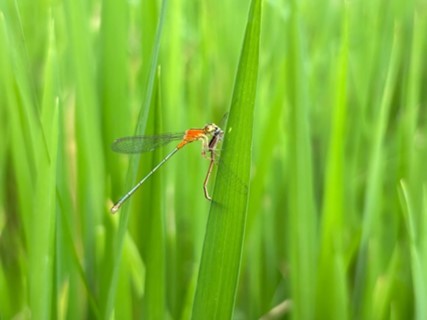
Download figure
Discussion
The observation of Ischnura senegalensis preying on Agriocnemis pygmaea provides significant insights into the predatory dynamics of Odonates in the rice field ecosystem. Such detailed documentation of the feeding behavior of I. senegalensis is rare in Sri Lanka, marking this as a valuable contribution to the understanding of Odonate ecology in the region 11.
The use of head-first chewing by I. senegalensis suggests a specialized predatory strategy that may provide this species with a competitive advantage in the rice field environment. This behavior, observed over a 15-minute period, highlights the intricate and effective predatory techniques employed by I. senegalensis, which could be a critical factor in its survival and dominance in this ecosystem 12.
Given the lack of comprehensive reports on the feeding behaviors of I. senegalensis in Sri Lanka, this observation fills a crucial gap in the existing literature. Understanding such interspecific interactions is essential for a broader comprehension of Odonate predatory behaviors and their implications for ecosystem dynamics. Further studies focusing on the frequency, impact, and ecological significance of such predatory events could provide deeper insights into the role of I. senegalensis within the Odonate community and the broader rice field ecosystem 13, 14.
Conclusion
This observation of interspecific predation by Ischnura senegalensis on Agriocnemis pygmaea provides valuable insights into the predatory behavior of damselflies in Sri Lanka. The documented feeding behavior, where I. senegalensis utilized its mandibles to consume the head of A. pygmaea, highlights a previously unreported aspect of the species' ecological interactions. The sustained predation process, lasting at least 15 minutes, underscores the predatory efficiency and specialization of I. senegalensis. This finding not only fills a gap in the existing literature but also contributes to a deeper understanding of the complex interspecific dynamics within Odonate communities. Further studies are encouraged to explore the prevalence and impact of such predatory interactions, which may have broader implications for ecological balance and food web structures in rice cultivation environments (Bambaradeniya and Amerasinghe, 2004).
References
- 1.Gunathilagaraj K, R P Soundarajan, Chitra N, Swamiappan M. (1999) Odonata in the rice fields of Coimbatore. Zoos'. Print Journal 14(6), 43-44.
- 2.Krishnasamy N, O P Chautian, R K Das. (1984) Some common predators of rice insect pests in Assam. India. International Rice Research Newsletter 9(2), 15-16.
- 3.A P Sumanapala. (2017) A field guide to the dragonflies and damselflies of Sri Lanka. Ceylon Tea Services PLC.
- 4.Mogi M. (2007) Insects and other invertebrate predators. Journal of the American Mosquito Control Association 23, 93-109.
- 6.Kadoya T, S I, Washitani I. (2009) Dragonfly crisis in Japan: A likely consequence of recent agricultural habitat degradation. Biological Conservation 142(9), 1899-1905.
- 7.Riservato E, Festi A, Fabbri R, Grieco C, Hardersen S et al. (2014) . Atlante delle libellule italiane – preliminare. Società Italiana per lo Studio e la Conservazione delle Libellule - Ed , Belvedere .
- 8.Khelifa R, Zebsa R, Moussaoui A, Kahalerras A, Bensouilah S et al. (2013) Niche partitioning in three sympatric congeneric species of dragonfly: Orthetrum chrysostigma, Orthetrum coerulescens, and Orthetrum nitidinerve: The importance of microhabitat. Journal of Insect Science 13(71), 1-17.
- 9.H K Janani, Karunanayake C, M B Gunathilake, Rathnayake U. (2024) Integrating indicators in agricultural vulnerability assessment to climate change. Agricultural Research. 10-1007.
- 11.A S Hendawy, M R Sherif, A E, M. (2005) Aquatic and semi-aquatic insects occurring in the Egyptian rice fields and hazardous effect of insecticides. Egyptian Journal of Agricultural Research 83(5), 493-502.
- 12.Takahashi Y, Watanabe M. (2010) Female reproductive success is affected by selective male harassment in the damselfly Ischnura senegalensis. Animal Behaviour 79(1), 211-216.
- 13.DUDGEON D. (1989) Resource partitioning among Odonata (Insecta: Anisoptera and Zygoptera) larvae in a Hong Kong forest stream. Journal of Zoology 217(3), 381-402.
- 14.Sarathchandra R L R, K D Ukuwela, R P Vandercone. (2020) Dietary ecology of common amphibian species in a seasonal location in northern Sri Lanka. Journal of Natural History 54(27), 1797-1812.
- 15.Bora A, Meitei L. (2014) Odonates (dragonflies and damselflies). , Umiam, Meghalaya, India, of Indian Council of Agricultural Research (ICAR), Research Complex for NEH Region Campus 2(1), 16.
- 16. Odonates of three selected tiger reserves of Madhya Pradesh. Central India. Check list 9(3), 528-532.